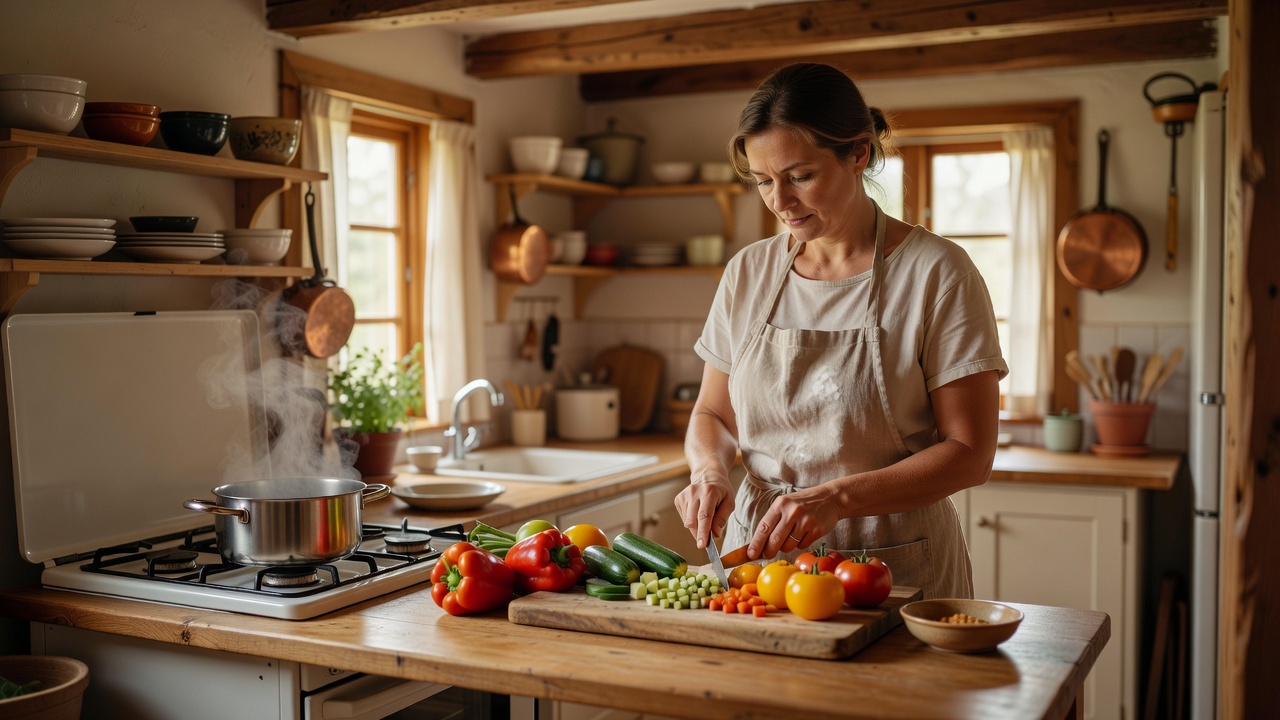
Begin with one ordinary meal
Notice what you reach for when making a meal you prepare often. Are the chopping boards behind a stack of serving dishes? Does putting the kettle on require moving a decorative arrangement? Those small interruptions matter more than whether every jar matches. A welcoming kitchen allows the familiar work to happen without constant negotiation.
Choose one stretch of counter to protect as preparation space. Move infrequently used appliances elsewhere only if you have a safe, accessible place for them. Keep the things you use daily near the task they support. A simple reorganisation can make existing cabinets feel more generous without changing a door or buying a storage system.
Store by use, not by appearance
Put everyday plates near the place where you serve or unload them. Keep cooking tools close enough to reach, but away from heat and other hazards. Give food containers a defined home, with lids easy to find. Before buying organisers, measure the cabinet and try a temporary arrangement using what you already have.
Open shelves can be attractive, but they also collect dust and cooking residue. Use them for items you reach for and wash frequently rather than assuming all closed storage should disappear. Secure shelving appropriately for its load and wall construction. In a rental, obtain permission before making changes; do not rely on adhesive products for heavy crockery.
Let useful materials bring character
A wooden breadboard, a cotton tea towel and a ceramic bowl can provide plenty of texture. They do not need to be new, matching or permanently on display. Select materials for cleaning and use first. Follow the maker's care instructions and keep food-contact surfaces in good condition rather than treating every old object as suitable for cooking.
Vintage pottery deserves particular caution. An attractive glaze is not proof that an item is safe for food, and chips or unknown materials are reasons to use a piece decoratively instead. The same practical approach applies to old enamelware. Enjoy its shape on a shelf if its suitability for daily food use cannot be established.
Warm the room without a renovation
Look at the colours already present in the floor, cabinets and worktop. A warm neutral textile or a familiar wooden stool may connect them better than repainting everything. If you are considering paint, check the surface preparation and suitability for the location. Test a sample beside existing finishes at different times of day.
Small hardware changes can be worthwhile, but confirm the fitting dimensions before ordering. Renters should keep original fittings labelled and seek any required permission. Avoid cosmetic coverings near heat, moisture or food-preparation areas unless the product is expressly suitable for that use. A change that peels or traps moisture is not a sensible saving.
Make room for company safely
A visitor does not need to stand in the middle of the cooking route to feel included. If space permits, provide a perch or a small table away from hot surfaces, sharp tools and appliance doors. In a very small kitchen, the most welcoming seat may be just outside the doorway, with conversation continuing across the threshold.
Keep textiles, trailing plants and decorative objects away from the hob and other heat sources. Follow appliance clearances and ventilation guidance. Lighting above a preparation area must be suitable for its position, and alterations to electrics, gas or plumbing belong with appropriately qualified professionals. Styling should never make everyday work less safe.
Choose a realistic order for spending
Start with cleaning, rearrangement and minor maintenance that is within your ability and permission to carry out. Next, address a genuine daily problem: inadequate task lighting, an unstable seat or a damaged storage fitting. Only then consider the finishing details. A room can look lovely and still be frustrating if the basic work happens in the dark.
Price the whole change, including fittings, delivery, installation and any repairs it reveals. Keep some money uncommitted rather than spending every bit on visible finishes. For many households, a well-positioned lamp in an adjoining dining corner or a properly fitted shelf offers more practical warmth than an entire collection of new accessories.
Leave evidence that someone lives here
The shopping list, the everyday mug and the bowl of fruit are not styling failures. Give them sensible places and let the room remain a working kitchen. A short reset after a meal—clear the preparation area, return the tools, put the cloth where it can dry—does more for tomorrow's welcome than arranging another display.